putting away childish things

It occurred to me the other week that I’m rapidly running out of time to play the ingenue. This is true, but it’s also irrelevant, given that not only did I never manage to pursue that career in theatre that I’d vaguely dreamed of but that I don’t even do the Waiting for Guffman thing these days, busy as I am selling out. I guess I’d just always harbored the illusion that someday I was going to play Eponine and it was kind of jarring to realize that even though I’m carded on a semi-monthly basis, that doesn’t make me a passable sixteen-year-old street urchin.

I quietly retired from theatre and ballet as I was going through my eating disorder a few years back. Mirrors, as you might expect, were an obvious trigger, as were costumes; simply having my measurements taken is a surefire way to make me skimp on eating. All that aside, I’d also been considering quitting for several months. Ballet class had become increasingly hard to make as I rose the ranks at work and I couldn’t imagine myself existing in some kind of in-between state where I took class as my schedule allowed, feeling less and less capable as the weeks went by. It had to be all or nothing.

For a long time I was content. My decision to give up a time-consuming hobby paid off at work, and I felt at greater peace with my body than if I had had to stare at it in a mirror for hours every week. Eventually, though, I started to dream about dancing. Every so often in my dreams I am wearing ballet slippers or even pointe shoes and sashaying across the floor or spinning like a top. I wake with a start and my legs feel heavy and clumsy, and for a few days I mourn my lost agility.

One of the things I’ve been most disappointed to discover as I grow older is that moving beyond an urgent emotion is not the same thing as getting over it. As it turns out, “getting over” something — closure — is a myth. I always thought that I was simply bad at it. I tend to harbor feelings for far longer than seems acceptable. Old flames will appear in my dreams, or their names will drift into mind at the oddest of moments. I think sometimes about both the men and the roles I’ve lost to other women and I feel bitterness stir within me, as though it hadn’t been twelve years since the time someone else’s name appeared on the cast list where I expected mine to be, as though I can even think of my fling with H____ without cringing at how ill-suited we were for one another. You’re supposed to be past this, I used to think to myself, feeling betrayed by a gut that won’t obey my brain.

In recent years I’ve come to be more forgiving of how I engage with my memories. A few months back, I took my first ballet class in three years. I felt immediately at home again in the studio, where my muscles remembered just how to lift my leg into an elegant developpe. Of course, just because my muscles remember how to do it doesn’t mean they actually can, and I looked in the mirror to discover that I looked like a hunchback since I can’t lift my leg higher than my waist without my back bending in half anymore. (It was rough.) But I was thrilled to discover that even though I kept falling out of my pirouettes, the joy I felt in my dreams was now manifest in real life. I didn’t need to find closure with dance; I could create a differently shaped space than the one that it used to occupy within me, and I wondered whether I might do the same with my other memories.

I thought about this again when I finally got around to reading Turtles All the Way Down the other day, on a plane. I think the Venn diagram of “people who have read Turtles All the Way Down” and “people who read my blog” is basically a circle, but for the uninitiated, it’s John Green’s latest gut-wrencher about teenagers who are just a little too articulate to be real navigating trauma. I am almost over John Green at this point, which is probably for the best as although I still get carded at the airport bar I am borderline elderly. Turtles All the Way Down still got at me, though, partly because I was drunk on a plane and listening to Paul Simon but mostly because John Green articulates universal truths about the human experience downright uncannily.

The funny thing about the plane I was on is that it wasn’t the plane I was supposed to be on. I was supposed to meet my boyfriend at the airport in Denver after he flew in from San Francisco so we could fly together to Spokane for Christmas. It wasn’t the first time I’ve met a boyfriend halfway through a trip so we could fly together on the final leg to a family holiday. Bizarrely, it wasn’t even the first time I’ve done so in the United terminal in Denver (which is a bleak place for an emotionally significant memory. Although there’s a great Mexican food place in the middle of the B concourse if you’re ever stuck there and hungry, which, if you fly United often, you probably will be someday).

For days I, being me, had been expending altogether too much energy contending with the prospect of replacing a memory that I reluctantly hold precious. I wanted to blow it to pieces and create a new one to take its place, knowing that what followed that afternoon in 2013 was a disaster, but I couldn’t fathom relinquishing it. Of course, United, being United, delayed my flight from New York to Denver long enough that I’d miss the flight from Denver to Spokane, and so I was torn from my reverie by the more immediate task of figuring out how to get to Spokane at the same time as my boyfriend — who was traveling from San Francisco — so that he wouldn’t have to meet my parents for the first time without me there. (Are you cringing? I’m cringing. It didn’t even happen and I’m still cringing. Bless Tina at the Premier desk for getting my butt into a seat on an alternate flight.)

And so I was on this flight, from Chicago instead of Denver, having dodged something of a bullet but ashamed to be hung up enough on a four-year-old memory that it was a relief to not have to confront it. It felt ridiculous to me that I could be as thrilled as I was to be bringing someone I love home to meet other people I love and still harbor — regret? Bitterness? It wasn’t even clear to me what emotion I was experiencing, let alone why, but whatever it was, it was exacerbated by the fact that I’ve been struggling to negotiate with the contradictions of that earlier relationship.

Lately, memories long dormant have cropped up again and others have appeared to me in a different light. I can’t say I repressed these memories so much as I filed them away under “something that made me uncomfortable for reasons I couldn’t articulate at the time,” but the zeitgeist is pulling them out of the filing cabinet and into sharp relief. Suddenly, I’m able to articulate what made me uncomfortable seventeen years ago in sixth grade typing class, thirteen years ago in the text messages a friend’s boyfriend kept sending to me unbidden, six years ago in the Downtown Cocktail Room off Fremont Street. Four years ago, in a relationship founded on a power imbalance.

I feel vindicated. I struggle with that word because it evokes celebration. Nothing about these memories is to be celebrated. I think many of us feel vindicated. That was wrong, we can say now, and we can’t do much about it but we can look at the men who wronged us knowingly, and assume that karma will get them someday, or it already has, and refile those memories under “something that made me uncomfortable because someone was reaping the benefits of patriarchy.”

But what of the memories themselves, which are hardly so black and white as to be definitively wrong? There are incidents that I’ve recast in my mind as wild, or flattering, or pleasantly unexpected, events that were as thrilling as they were discomfiting and I don’t know what to do now that I can locate them in the moral grey area. I thought I was past these memories and all that they represent and suddenly I must negotiate with them again, and consider whether they invalidate the precious things that followed.

It feels untoward to conflate my relationship with ballet and theatre or even my memories of being treated poorly or like an object with the horror show coming out in the media and my Facebook feed of late. My stories may not be black and white, but they bothered me, and they changed me, and that’s where I see the thread emerge. I had to acknowledge that the hobbies I loved so innocently as a teenager were destroying me as an adult. I decided to remember each of these incidents as positive in some way, because I didn’t have the vocabulary to say that they weren’t, and being forced to acknowledge the ways in which they were wrong is disorienting.

In everything, I’m learning to rearrange the ways in which I hold my passions and my memories. I brought up Turtles All the Way Down because there was a line that really struck me on a day when I was feeling overwhelmed by a memory that was cropping up when I didn’t want it to of a moment that was part of a pattern I now recognize as damaging. I’m sure you’ll see some version of it tattooed on today’s fifteen-year-olds in three years when they’re old enough to do that, but for now:

“You remember your first love because they show you, prove to you, that you can love and be loved, that nothing in this world is deserved except for love, that love is both how you become a person, and why.”

Love is how you become a person. It’s hardly novel to say that each of us is who we are because of what we’ve experienced, but it feels untoward to acknowledge the role that those experiences — long past — continue to play in our adult lives. But adulthood, I think, is a matter of learning how to hold truths that contradict one another, because each truth was at one point valid. Every truth, in its own time and its own context, is how you become yourself.

I was a dancer and I remember how it felt for my body to be an instrument, how it felt to be beholden to that instrument, how it felt to retire it. I loved someone who damaged me and I remember how it felt, at first, to be treasured. I love someone now who won’t damage me and we can create new memories that don’t obliterate or invalidate the older ones. I can hold old memories sacred and they can coexist with memories that are so, for lack of a better word, fucked that they only come out in those rare moments where I feel raw enough that I can share them. Love is how you become a person but so is ambition, and so is trauma, and so often all three of those are intertwined in ways that only become apparent long after you’ve negotiated with each of them.

I don’t have to get over anything. I only have to tuck it away in the back of my closet where I store my first pair of pointe shoes and my correspondence and my college dance company sweatpants that I cannot bring myself to throw away even though they’re a really heinous shade of purple (sorry, B____ H___). Knowing my catalog of memory by heart doesn’t mean I’m crazy — not being able to have my measurements taken without quitting bread for a week makes me crazy, but still being mildly annoyed that the guy I went on my first date with broke up with me via text message doesn’t! — or obsessive. Allowing memories to retain the significance they once held doesn’t preclude me from ascribing a new layer of significance to them. I’m a storyteller and I know the story of my own life intimately. It doesn’t unfold as neatly as a novel. It’s endless and multifaceted and illogical. I hold it sacred, since it’s how I became a person.

i contain multitudes of data

This is part 3 of an ongoing series about the Internet. Previously, I explored the positive role that social media can play in modern life and bemoaned how e-commerce has bastardized the art of writing. I don’t have future posts planned for this series, but stay tuned several years from now for my Silicon Valley tell-all, working title The Emperor Has No Track Jacket.

A few weeks back Twitter served me a Netflix ad promoting the new season of “Stranger Things.” I wondered briefly, as I often do, whether what feels like algorithmic ad targeting is actually just the result of a chip having been surreptitiously implanted in my eyeball at my last eye appointment. (You know, that thing where they touch your eyeball with a laser? That cannot possibly be medically necessary. It’s obviously The Man.)

How else would Twitter have known that just the night before, I watched “Stranger Things” for the first time? I made my boyfriend turn it off after one episode because I’m afraid of the paranormal and also because now I understand why my best friend keeps telling me to be Eleven for Halloween and I can’t decide whether to be offended or not, but that’s beside the point. We were using his Netflix account, so I couldn’t possibly have left a digital footprint. I don’t even have my own Netflix account, not because I’m an overgrown child who still uses her parents’ credentials but because… well, that’s beside the point.

What does it mean to be so predictable that an algorithm can guess what I was watching last night? As a teenager I struggled a great deal with the notion that I could be reduced to a set of numbers. I felt both unprepared for the promising future that my numbers implied and constrained to the kind of future that could be promised by numbers. (You can only imagine the durm und strang had I gotten an actually good SAT score!) I find it incredibly frustrating today that after finally having broken out of the cycle of numbers that is secondary education, I can somehow once again be described by data. I was under the impression that I contained multitudes. And I do, I suppose, but measured in a metric that translates directly to cash.

Algorithms can, I suppose, know both who I am and what I mean, more so than even I myself do. I trust them to tell me what to watch next — or at least I would if I watched TV, which I still don’t, although I did enjoy the first season of “The Unbreakable Kimmy Schmidt” — and what music I might enjoy. It’s fashionable to wisecrack about how your casual Google searches turn into targeted ads on your Facebook feed and good practice to use an incognito window when you’re trying to figure out if, say, pregnancy tests expire. I’m not usually a nihilist, but I get a kick out of Googling everything from my own profile just to fuck with the ad targeting algorithms. No, I’m not interested in buying a tiny house, Google, I just want to read a bunch of schadenfreude-inducing horror stories about how many people who buy them get divorced within ten months of moving in. Take that!

It’s actually pretty freaky, though, that I can post an Instagram story from a fancy restaurant one day and get an ad for Louis Vuitton the next. It makes me ask myself whether I should be shopping at Louis Vuitton if I’m going to fancy restaurants now, as if I should trust the signals of my behavior that inform how algorithms treat me as guideposts for what I should do next, too. (You’d think Instagram would recognize that my single visit to a Michelin-starred restaurant was an anomaly, given that it was bookended by visits to a dive bar that hands out free pizzas with your beer and evidence of my sad attempts at Blue Apron, but the singularity isn’t here yet.)

I am reminded of learning about symbolism in high school. I was convinced for a while that it was a conspiracy of my high school teachers to find something interesting to say about The Scarlet Letter, that surely Nathaniel Hawthorne was simply describing the Bostonian flora. You can’t possibly claim to know definitively what a dead man meant to say, I would grumble to myself as I dutifully typed out essays that I trusted would get me the As I needed to maintain the perfect GPA that was the hallmark of my presence here on Earth.

It didn’t occur to me to wonder what I was working toward beyond that number and it’s only in the last year or two that I’ve realized how much numbers crippled me when I was younger. Since the election I’ve been reading intensely, first as a means of proving myself right and lately as a means of understanding why it doesn’t matter whether I’m right or not. I aced everything in high school, so I believed that I’d learned everything, but the world and its systems are at last revealing themselves to me as too complex to be distilled down to answers on a multiple-choice exam.

Though high school prepared me poorly for critical learning, it prepared me well to navigate today’s Internet, which demands precision. I feel constantly anxious to prove myself with facts, as though my thoughts are worthless without data behind them. It’s the corollary to how I feel when presented with a targeted ad: should I just give up and buy some Allbirds since obviously I’m supposed to be wearing them given how frequently I am in Palo Alto? Does the fact that I think they look like stupid slippers mean nothing if all of my behavior signifies that I’m the kind of person who should buy them?

In essence it’s the same problem I have with content marketing: the notion that all you need to thrive is a playbook. Get the grades, get the degree, get the job, and happiness will follow. Dangle some keywords in front of people, context be damned, and watch them flock to your product. Let formulae tell you what to do and never make a bad choice again.

But the cybernetic approach to everything saps the power of human subjectivity and free will. I used to shop impulsively. I bought clothes because they were soft and books because they were on sale. Now I follow fashion and check out the ebooks that my library recommends to me. I wonder if I’d live more impulsively if I didn’t have a constant ticker of advertisements and my friends’ experiences and fucking sponsored posts following me around. I booked my first real international vacation — Japan — because in 2013 I picked up Kafka on the Shore from my parents’ bookshelf and it transported me to a world that I knew I had to see to believe. (I was disappointed to learn that the talking cats were a fictional device, not a cultural difference.) I don’t feel quite as inspired to follow flights of fancy as I did just a few years ago. I’m not sure whether that’s because I’m growing older or because technology is eating away at my human subjectivity.

Data — the systematic recording of facts in forms that can be made useful — is immensely useful. Machine learning is, too. I haven’t worked at a certain “Big Data” “unicorn” for five and a half years because I really like track jackets. Used well, data and technology will improve the way we live. I believe in their power, but I also believe in creativity. I believe the best art is art that responds to context, not trends. I believe in the power of context to make art meaningful and I believe in the power of art to mine meaning from context. I struggle to reconcile my desire to live impulsively with how easy it is to select a book from the curated list that the eBooks app shares with me. I struggle with how violated I feel when an algorithm tells me that it knows what I was watching on the couch with my boyfriend last night.

At the end of the day, I am well aware that connectedness and convenience aren’t free. I love social media, I love the ease of living in a technologically advanced society, and I mostly feel happy to subsidize it with my data, not my money. It’s sort of like the calculus I use to justify buying an extra pair of pants on ASOS to qualify for free shipping even though the pants are ultimately more expensive than the shipping would have been. Only instead of pants, I get a debilitating spiral into questioning whether I am still a human with free will or just a pair of eyes that should be watching “Stranger Things” attached to a body that should be wearing Allbirds powered by a mind that couldn’t possibly have voted for anybody but Hillary* and fueled, probably, by Blue Bottle.


* I obviously voted for Hillary. Come on, I’m not watching Infowars.

the medium is the message

This is part 2 of an ongoing* series about the Internet. Last week, I talked about how social media was my conduit to self-actualization (at least once I emerged from underneath the rock where I’d been hiding from Instagram for five years). This week, I counter that thesis by arguing that the Internet is a medium that is destroying our messages, and I’m not just talking about being limited to 140 characters. Next week, I’ll write about the meaning of identity in the machine learning era.

*It was going to be 3 parts and then it was going to be 2 parts but now it’s going to be 3 parts again and in the course of writing those 3 parts I’ve realized that I have A LOT OF FEELINGS ABOUT THE INTERNET, so why limit myself?

I didn’t expect that trying to learn about search engine optimization would trigger my latest existential crisis, but there you have it. (It’s been that kind of year, hasn’t it? I can’t figure out if it’s the omnipresent threat of nuclear war or if this is just what it’s like to be 28.)

I was trying to figure out what you’re supposed to be doing if you actually want people to read your blog. This in and of itself wasn’t that eye-opening, because I know perfectly well that there’s a metric fuckton of content on the Internet and you’re supposed to be doing some voodoo magic to make sure that when people Google “Dana Cass” they don’t come up with someone’s Florida mugshot. (Someone else’s. I’ve never been arrested in Florida, although I did consider burning down Harry Potter World when I went there in October, realizing that I had paid the equivalent of three new pairs of shoes to lay waste to my most precious childhood memories. The frozen butterbeer was really good, though.)

So I’m reading about SEO, which already feels like the used car salesman patter of the digital age, and then I came across this saga of how mattress reviews are actually just a proxy for the battle to dominate an oversaturated market. And then I was trying to figure out what to do with my books while I’m living abroad next year, and it turns out you basically can’t find anything unbiased about long-term storage. It’s literally all so-called sponsored content. (Pardon me if I don’t link it here lest I negatively impact my SEO with links to low-quality content. You, too, can Google “long term storage nyc” if you want to dispel the few illusions you had left about the democratization of information being net positive.)

“Indeed, it is only too typical that the ‘content’ of any medium blinds us to the character of the medium.”

“Sponsored” is a euphemism for “paid,” which means that what you’re reading is an advertisement disguised as neutral information. This is not the first time I’ve thought about the elusiveness of truth on the Internet. As it turns out, that’s a hot topic lately. But I’ve felt lately that a number of threads I’ve been tracking are beginning to converge, specifically: there is a metric fuckton of words on the Internet and consequently, the words themselves matter increasingly less.

I was reading some casual media theory a few weeks back. (Quick piece of advice: reconnecting with my academic self has been a great way to navigate the apocalypse without going completely insane. I balance out the New York Times with selections from my college bookshelf.) I didn’t spend much energy in college on anything that happened in the past hundred years. I spent most of my time on the nineteenth century — including a semester where, memorably, I managed to write more than one final term paper on the relatively narrow topic of the Shakers — so last month was the first time that I’d actually read Marshall McLuhan of “the medium is the message” fame.

In the course of my work, I spend a lot of time thinking about data and technology and the impact their use and misuse have on our daily lives. I spend much of my spare time writing. I don’t often think about the connection between the two beyond how I apply my talent as a writer in service of my company, where I was hired in 2012 to write proposals and white papers. I had heard the term “content marketing” and I assumed that that was what I was doing: writing things to get people to buy something. It was only when I started applying to content marketing jobs that I learned that even though I’m a better writer than most people I know, writing is not actually the point.

An entire massive cottage industry has sprung up around “content marketing,” which is not the art of writing well to describe what your company can offer a client but the science of getting in front of as many eyeballs as possible. It’s “the medium is the message” taken to the extreme, where every resource is brought to bear against the medium and the message itself is, if anything, an afterthought. The objective is no longer truth or even precision but rather a sort of association, where if you walk away thinking Manhattan Mini Storage is long-term storage the content marketer has done their job right.

“The effects of technology do not occur at the level of opinions or concepts, but alter sense ratios or patterns of perception steadily and without any resistance. The serious artist is the only person able to encounter technology with impunity, just because he is an expert aware of the changes in sense perception.”

I have always held writing as sort of a pure act, even in the context of my profession. I write to convey truth. I don’t hold sales or marketing as antithetical to the pursuit of truth, at least not in their traditional forms. Content marketing, though, strikes me as a bastardization of my talents as a writer. Nobody has any illusions about the intent of a proposal or a white paper or even an advertisement on the subway. But an advertisement disguising itself as advice on how to improve your work from home experience? No, thank you. Stick with product placement and let the writers pursue their truth. (And when it comes to how the art of writing has been bastardized in service of moneymaking, don’t even get me started on internet journalism.)

Some time after I discovered that I can’t be a content marketer because I didn’t come out of the womb knowing how to optimize my blog content for search engines, I moved to a new role inside of my company. Today, I often help people who aren’t speakers prepare talks for large audiences. Most of this work is therapy — reminding people that “The audience wants to hear you share what you have to say!” in hopes that they will remember that their arms are attached to their bodies and that they might even consider occasionally moving them — but a surprising amount of it is simply trying to get people to just say what they’re trying to get across in plain language.

How does this relate to content marketing? It’s just another symptom of the epidemic of not being able, or no longer caring, to speak meaningfully. I work mostly with engineers who think a lot about data — information — and how to make it usable. They tend to think about speaking in the same way, where the actual thing that they’re trying to say is secondary to the way in which they say it. “So I’m going to talk about x, y, and z,” they tell me. We go into rehearsal a few weeks later, and they talk all around x, y, and z, and they ask me for ways to visualize x, y, and z, and at some point I look at them and say, “Well, why don’t you just say x, y, and z?”

Every time, it’s somehow a revelation to both of us that it can actually be that simple. In a world where we are inundated by content, speaking truth without the trappings of search engine optimization or fancy slides feels as impractical as speaking truth without a microphone. The message doesn’t matter if it’s buried in the medium. (I think I’m abusing McLuhan here, but bear with me.)

That’s upsetting, isn’t it? I’ve been in ongoing conversation with a singer-songwriter friend of mine who recently deleted his Facebook account because he’s sick of how promotion on social media — and, increasingly, success as an artist — depends on your ability and willingness to manipulate the ranking system. He doesn’t feel like tying his success to his being able to fund Facebook ads, nor does he feel like his success should be something that Facebook gets to monetize.

This is even more insidious when you think about the inevitable politicization of the mediums we’ve come to rely on to speak our truths. Maybe it was idealistic to think that art and truth were pure — patronage has always existed; newspapers have always had editors — but today it feels that they are elusive. Before the Internet democratizes information, it bastardizes it. Why are you reading what you’re reading, or listening to what you’re listening to? Who paid for it to reach you? What’s their end goal and how do you, the the content consumer, figure into it? Are you the actor or the audience and who wrote the script, anyway? Do art, truth, and opinion still exist or are they all just a function of who’s paying whom to do what? 

And man! All you wanted to do was buy a new mattress.

pics or it didn’t happen

This post is the first in a two-part series about the Internet. In Part 1, below, I write a pages-long excuse for wasting all of my time on the Internet. In Part 2, I’ll illuminate the inseverable connection between trying to buy a mattress and the declining art of writing. Keep yourselves busy in between posts by contemplating whether Twitter will, indeed, be the downfall of Western democracy.

I got Instagram in June. (Yes, this June. In 2017. I still don’t know what David S. Pumpkins is, and I can’t confidently identify dubstep, but I get millennial pink now. It’s a start.) What converted me, ultimately, was being in Stockholm on the longest day of the year. I was so overwhelmed by the beauty of the waterfront that I could think of nothing but how best to brag about seeing it.

I avoided Instagram because I have a fraught relationship with my own image. I can think of few photos taken of me over my lifetime that I can stand to look at, fewer if I don’t count the ones where I think I’m cute only because I’m so cringingly awkward, fewer still if I tell myself not to look fondly on the photos from when I was starving myself. I’m not sure if I want to get married in no small part because I so dread the photos. I dread looking at them and I dread what I will do to myself to create photos that I can tolerate looking at.

But I’m a child of the Internet, a geeky, lonely kid who didn’t understand that there were people like me in the world until I found them on the message boards of the early 2000’s. The Internet was the first place where I felt that I could be myself — and the place where I learned how to reinvent myself. (Did I once stage a dramatic departure from a message board I frequented then re-register under a new screen name just to see if I could make strangers believe that I was a different person than the one they already knew? I’m not saying I did, but I’m also not saying that I haven’t known from a young age just how distinctive my voice is.)

When social media took over the message board as my Internet drug of choice, I fell in love with what I saw as a new tool for self-expression. I was about to make a crack about how I mean self-expression, not corporate brand expression, but then I remembered how much I love that I can tweet at United when my flights are delayed, for example by sending them them a prose poem in the style of “Rime of the Ancient Mariner” 140 characters at a time if they strand me at Heathrow for 29 hours. It was more productive than taking myself on a pub crawl around the four Star Alliance lounges in Terminal 2, which I know because I also did that. And having to acknowledge that fast-food restaurants are now sentient entities that communicate with one another feels like a small price to pay for being able to channel my constant, low-level rage at United to United.

I’m being facetious — as a former customer service professional I don’t make a habit of attacking them — but more to the point, I am who I am as much because of my Internet presence as my physical presence. I dated a man who, on principle, avoided social media, and while that was hardly the only way in which I wasn’t my authentic self in that relationship, it felt more significant than I would have anticipated. If you don’t follow me on Twitter, can you really know my id? (My id, apparently, wants to troll customer service professionals who represent airlines that fly planes from the Soviet era. We all have our vices.) My Twitter self is an abstraction of my physical self that gleefully flouts the rules of grammar, communicates complex sentiments with images instead of trying to unpack them with words, and blurts out shameful thoughts in a way I never would aloud. I see Twitter as a place where I can put this version of myself on display in a sort of ironic light that exists separately from the articulate, measured identity I strive to cultivate in real life.

Much of what I loved about the Internet as a child and young teenager was how I could exist in words but not being. I wasn’t an ugly child, but I was a gawky one, and I felt limited by the body that I lived in. It wasn’t that being on the Internet allowed me to pretend I looked different than I did — I think all of us spending time online in the early 2000s were well aware that none of us were secretly babes, you know? Even better, it was irrelevant. I was my brain and my wit and nothing beyond that mattered, except my sweet avatar.

In 2017 it feels tragically unhip to be enthusiastic about social media. I think I’m supposed to be casting aspersions on people who post frequent status updates on Facebook because #YOLO, and it’s bad to think about what your life looks like to people on the Internet rather than simply live it. It’s like being twelve again. I know that Internet cool isn’t properly cool but frankly, I don’t feel like I can be cool in any way except Internet cool. (And Facebook isn’t even Internet cool anymore. I’m fucked, basically.) Not having Instagram had always been a minor point of pride for me. Like, I was an Internet-obsessed loser, but at least I wasn’t part of this weird cult of disembodied hands holding ice cream cones.

But then I went to Stockholm.

Over the past couple of years I’ve become a frequent traveler. I look at my passport as a symbol of triumph over adversity, and I don’t just mean that I have listened to to four screaming babies in dulcet harmony for eight hours without throwing myself out of the overwing exit. For many years I was so afraid of flying that I couldn’t really do it without medicating myself. And within that period, there was a long time when the idea of putting myself in an unfamiliar environment — i.e., one where I couldn’t rely on my food and exercise routine — was unfathomable. Even after the worst of my eating disorder had passed, travel still felt like something that was beyond me. There’s more than a paragraph’s worth of material to uncover here, so obviously I’m going to save that for the next time I want to write something really clickbaity that gets me on the WordPress Discover page (“How I stopped worrying and learned to love the fact that if you’re in France, there is no breakfast but croissants”).

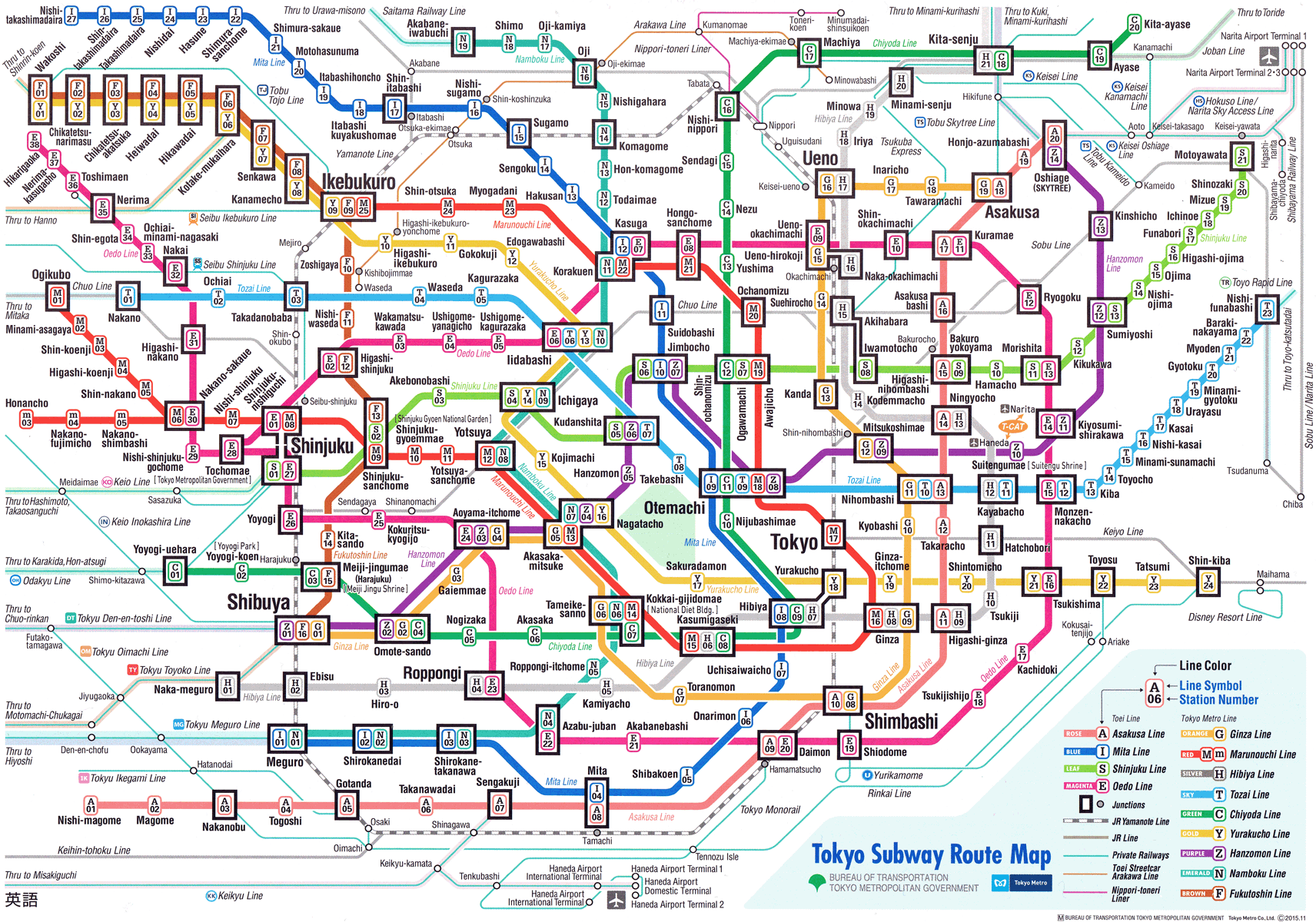
Travel has become one of my favorite ways to get out of my own head. I’m too disoriented by jet lag and language barriers and the staggering weight of history to worry that I’m not supposed to be eating simple sugars for breakfast. When I look up from the Marienplatz or down at the Tokyo subway map, I’m free from the burden of thinking. I need only react. (Especially because Google Maps is really good with Tokyo subway directions. Otherwise I’d probably still be wandering around Shinjuku, living off corn-soup-in-a-can from the alleyway vending machines.) And I get to look constantly outward, away from myself.

In Stockholm, I wanted to share what I saw when I looked outward. Stockholm is impossibly precious in a way that makes me want to peer around every corner to make sure that I’m not missing some charming little staircase tucked in an alley that in New York would just be another place to store the trash. It’s the kind of place that feels worth getting off your couch to explore. But I have long felt overwhelmed by leaving my house. Inside, in the confines of my routine, I know what I have to do to feel accomplished; outside, the world overwhelms. I lack the rules to navigate it and it refuses to conform to my expectations. Instagram gave me a framework: a means of knowing what I was setting out to do and, ultimately, to do it. “Look,” I could finally say, “I left the house, finally, and it’s scary, and there were screaming babies on the plane, but aren’t you proud of me? I left the house.”

The zeitgeist would have you believe that the keep-up-with-the-Joneses pressure of social media is net negative. Quitting Instagram is the new quitting gluten (probably healthy but mostly an opportunity to show your moral fiber). Looking outward can so easily deteriorate into comparing yourself to the rest of the world and invariably coming up short because you don’t have an eight-pack or a baby or interior decorating skills.

For me, looking outward is what I do to remind myself that the world is there to experience — and now Instagram is what I use to remind myself to experience the world. I recognize the paradox. I leave the house so I can find photos to prove that I left the house. And, critically, I am not in those photos. It’s not like in college, when every weekend meant a new slew of Facebook photos that I could only cringe at and criticize. I feel, like I did in 2002, that the body I live in is irrelevant. It’s only a tool and when I use it as intended, instead of letting it lie fallow or cultivating it beyond practical utility, I can climb a mountain or even visit Hogwarts.

And anyway, I like to people-watch. I like to read fiction and magazine profiles. (It occurred to me recently that if I never achieve notoriety such that someone is tasked with writing a magazine profile about me — or if by the time it happens, magazines no longer exist — I might need to pay a freelancer to write me one before I die. Just to have, you know? I just really want to know how they describe the way I eat my lunch salad and see how far backward they have to bend to depict my home generously.)

Social media is just another lens through which I can observe human behavior. I find it terrifically fun to look at how my friends and family live their lives. I scroll through Instagram and wonder idly whether I, too, would like one day to travel to Hawaii (sure) or have children (nah) and admire how other people manage to hang their curtains straight. I empathize with people I’d otherwise be quick to judge — I can’t stop thinking about @butlikemaybe who has made me realize that maybe liking brunch and being perceptive aren’t mutually exclusive — or whose plights I’d never consider. I have college classmates whose work opens my eyes to how the structures that have elevated me over the course of my life have served to oppress others. And all this on the same platforms that are disrupting Western democracy and forcing me to listen to long-lost high school friends pontificate about healthy eating like they weren’t the ones begging to hit the Del Taco drive-through at 4 A.M. after the club!!!

The Internet has always been the most powerful tool I have to cultivate the image that I want to present to the world, and now it’s the most effective way for me to understand a world beyond the one that I encounter in my daily life. As a child, it was where I discovered that there were people in the world who wanted to listen to me. In college, when a classmate created a Facebook group called “Dana Cass’s Facebook Statuses are the Highlight of My News Feed and My Day,” it occurred to me for the first time that words could be my profession. (S_____, if you’re reading this, I’m not sure I ever thanked you properly for that.) Today, the Internet inspires me to cultivate a memorable and, yes, enviable life, and to strive for an offline life that extends beyond the borders I was born knowing. When the call comes in now, I go, whether it’s a work assignment on the other side of the world or just an evening on a rooftop in Brooklyn. Going, I’ve learned, is better than staying. Going means finding a photo to share — and stories to tell.

these changes ain’t changing me

It occurs to me now that this story is wasted on the young. As a child, I found it overwrought. Then again, I was the kind of insufferable pedant who insisted on pointing out that I was ten and a half or turning thirteen next month. To me, the delta between just-turned-twelve and twelve-plus-eleven-months was significant enough to merit pointing out. And that made the idea that you were somehow harboring past and lesser versions of yourself like a parasite preposterous.

These days, I don’t put as much stock in birthdays as I once did. 21 ruins it, I think: the difference between “surreptitiously taking shots by a mailbox on your way to a party” and “drinking a beer while sitting on a legitimate chair in a licensed establishment” is profound enough that nothing else really comes close. I suspect that your twenties are the only time when you don’t fixate on aging, and given that I spent my childhood obsessing over how much better nine would surely be than eight has been, and that from what I understand I’ll spend my thirties wondering whether I should freeze my eggs just in case I wake up one day not trying to figure out a workable solution for flying babies in the cargo hold instead of the passenger cabin, and then from there it’s just constantly counting my gray hairs and wrinkles, it’s kind of a relief.

Sure, sometimes I look in the mirror and panic because I think I went gray overnight before I realize that I just forgot to comb in my dry shampoo, but those moments are few and far between. More often, I feel like the same person I was six years ago, only with a better wardrobe. (As an aside, I just put my last remaining Forever 21 garment in a bag to take to the thrift shop. It’s a shirt by strict definition, but I definitely wore it as a dress to at least one Vegas club, which tells you all you need to know to agree that throwing it out before I turn 30 is the right choice.)

A coworker of mine, someone quite senior in my company, said to me the other day that what I say carries substantive weight in our organization. “That means a lot,” I said, because it does. I don’t think of myself as having substantive weight. I think of myself still as I was at 23, a little precocious and certainly talented but hardly substantive. I am marginally more jaded than I was four years ago, but most of that has occurred over the past seven months. (I’ve developed an obnoxious habit of repeating “We’re all gonna die” to my boyfriend in conversation. He’s as pedantic as I am, so he can’t argue this point, but it’s not really helping either of us deal very well with our impending dual Russian citizenship.) But it’s hard to conceive of myself as anything like… substantive.

I have a tortured relationship with my youth. I chalk much of this up to the confluence events that made 24 such a disaster, starting with the bizarre relationship that I had with an older man who, over several months, went from fetishizing my youth to demonizing it. At the same time, I was nearing my Silicon Valley expiration date, the point at which you’re no longer the wunderkind and if you don’t start proving your relevance, you’re about to get crowded out by all of the Princeton alumni getting off of the Goldman Sachs elevator with their loud voices and their impenetrable business jargon. And also at the same time, I was starving myself down to what I weighed when I was twelve, and it turns out that you can’t really do that without also starving yourself down to the emotional faculties of a twelve-year-old.

I was at once too old and too young and I’d become completely unmoored from that only reliable marker of age, the body. And frankly, I’d also mostly lost my mind. I was functioning, kind of, but stagnating, even regressing, just as everyone around me was discovering their mid-twenties selves. A few months after I started learning how to eat again, three of my teammates at work—two of whom I’d started within three months of and one of whom I’d helped hire—were promoted. And as much as I appreciate that my friends knew to elbow me at the end of a meal and congratulate me for eating it, it’s a little demoralizing to compare rediscovering your beer belly to being handed a set of responsibilities to own and a fancy title to go with. (Granted, this is Silicon Valley we’re talking about, so the titles are mostly things like “Ninja” or “Droid.” It is not unthinkable that living in an environment where jobs are named after Star Wars creatures and everybody rides around on scooters wearing T-shirts has also contributed to my sense of perpetual immaturity.) Instead of getting to enjoy growing up, I felt trapped in my youth, the thing that had made me special until my ex-boyfriend called it my affliction, like a Dorian Gray bargain gone uniquely sideways.

For so long I identified more with the eleven-year-old on her birthday than I ever did as a child, ever conscious of the 24-year-old fitted inside me like a matryoshka doll. It’s jarring, welcomely so, to be reminded that I’ve grown layers beyond that one. That I’m 28 today and that sometimes I argue with the directors of my company and they listen to me, and that I pay my own rent and I would do my own laundry if it weren’t such a goddamn hassle in New York, and that even if I don’t do my own laundry, I have never run out of underwear, except that time I got stuck in London for an extra day last December and had to wash what seemed like the cleanest pair in the sink of my Heathrow hotel room with hand soap. (These were extenuating circumstances and should serve only to demonstrate what a sophisticated jetsetting individual I am.)

The other day, my coworker asked me if I was planning to buy a beach house soon, and while it turns out that that was mostly because that’s a normal thing for well-to-do adults to do in Sweden because there are “so few Swedes and so much coastline,” I only sort of laughed in her face, because it’s finally occurring to me that I am 28. (And yes, this post was paid for by the Sweden tourism authority.) I’m 28 today, and 27, and 26, and I’ll spare you the rest because I’m pretty sure you know how the story goes. And I’m 24, still, too, but I don’t need to worry about that anymore. It’s buried somewhere underneath all of the beers I drank on Pier A on Saturday surrounded by friends who have been shedding their skins alongside me since we were eighteen, nineteen, 23, 26, below the compliment of being told that I am thoughtful, substantive, that I carry weight. It’s nice to carry weight again.

teenage dream

Every so often, I give up on pretending that I have sophisticated taste in music and turn on the kind of thing I used to wallow to in high school. It’s a sure ticket to the past, which has been especially welcome lately—nothing like escaping to the good old days when the president was just a war criminal and Chandler’s mom was still a punch line on Friends, am I right?!—and easier than ever now that everything’s on Spotify. (Just remember to turn off sharing, unless you’re proud that it’s 2017 and you’re still listening to Something Corporate. You shouldn’t be, in case that wasn’t obvious.)

So the other day, in between wondering if I should quit my job and counting the number of dystopian novels that I didn’t think to take as cautionary tales, it occurred to me to turn on Jason Mraz. While he’s arguably a better musician than most of his contemporaries on my high school playlists, it’s still difficult to justify the existence of a lyric like “it takes a crane to build a crane,” and let’s not even broach the subject of his newer albums. Like Alanis in the Jagged Little Pill era versus Alanis now, it would be for everybody’s benefit if he’d just get dumped already. Success in love does not a good singer-songwriter make.

To step back into my teenage shoes, though, is to set aside the issue of quality. More precisely, it’s to set aside nuance. On many counts, I was inarguably a better person when I was a teenager. For example, when I was seventeen, I submitted an essay proposing that Congress vote anonymously to authorize military actions overseas to “allow politicians greater freedom to vote the way they feel is correct rather than be pressured by the party line.” This is probably not even the most preposterous thing that I thought was practical when I was a teenager, but it’s the only one I still have in my Dropbox, so it’ll have to do. Later in this essay, I also suggest that the United States would be able to end the genocide in Darfur—it was 2007—“if only we were willing to commit the troops to do so.” (Those troops, of course, would be committed through anonymous vote. Like YikYak, but for war!)

“Better” probably isn’t the right word: I was, if anything, purer. I thought that Congress was made up of good people who were simply at the mercy of their uneducated constituents. I thought that “it takes a crane to build a crane” was a genius observation that had never been articulated better. (I sort of still do. Congress, on the other hand, is obviously a lost cause.) Today, I can argue myself in circles; where I once nearly stormed out of the classroom in a heated debate with my World Affairs teacher over the best way to end the practice of female genital mutilation, I now hear myself using the dreaded phrase “I see where you’re coming from.” And I don’t even follow it up with “…and it proves my hypothesis that you’re a goddamn sociopath who wouldn’t recognize nuance if it punched you in the face.”

I miss the comfort of certainty. Writing cringingly naive social studies essays, blasting something like “Coin-Operated Boy” on my way through the Del Taco drive-through… nowadays it takes me a solid thirty minutes to decide what to order from Seamless, and even then I only pick because I know that if I don’t have something more than stale pretzels in my apartment within the next 45 minutes, I will chew off my own arm. (This is also in part why I don’t cook. I cannot handle grocery stores. I would say it’s an eating disorder thing, but it’s the same reaction I have to the New York Public Library eBooks catalog.) I’m too aware at any given juncture that whatever route I take will inevitably be the wrong one. What I wouldn’t give to be seventeen again and know that I am, without question, right!

Now I’m all too aware of nuance, and it means that I’m incapable of going in anywhere with guns blazing. That’s not entirely true, as just about all of my coworkers and the senior leadership of my company can attest to, but that blaze flames out so quickly, the second I open my eyes and realize that there’s another perspective to be considered. My intractable stubbornness has given way to… waffling. I’ve been catching myself lately vacillating wildly between different positions depending on how well they’re being argued to me. Protests are useless! “But they’re the only way to get the public read onto a cause! Look at how the attorneys mobilized via social media to help out travelers being detained at JFK!” Okay, protests are great! “They’re political theatre!” Those pink hats are still ugly! Okay, I’m done now. That one is an incontrovertible fact.

I guess the tradeoff is that while I might no longer be bullheaded enough to get myself sent to the dean’s office rather than submit myself to standing during the Pledge of Allegiance, I’m also no longer dumb enough to, say, get myself sent to juvenile court with a summons for drinking underage (in full “seventies roller disco regalia.” With tube socks. After trying to hide under a car). Or leave a Burger King soft drink cup full of Dr. Pepper in my cupholder for hours in the Las Vegas sun and not expect the cup to give way, sending Dr. Pepper leaking… everywhere. Or forget to look behind me before I make a U-turn and send my car straight into the path of an automated gate, practically knocking my bumper off (Dad, if you’re reading this, that’s the genesis of that massive scrape on my back bumper. Not a shopping cart. Just in case you happened to have bought that airtight excuse).

That isn’t to say that I’m not still incompetent—have I mentioned yet on the blog the time last year that I managed to miss a transatlantic flight by a full 24 hours?—but that nothing seems as consequential as it did when I had no concept of nuance. The photos of me wearing tube socks haven’t yet sunk my political campaign. I cleaned up the Dr. Pepper. (And United didn’t charge me for that mishap, which is probably because I have already sold them my soul.) It got better, as they say.

But that, too, is why the music I listened to when I was sixteen doesn’t resonate the way it used to. Everything felt so final, or so urgent: I needed Jason Mraz strumming his stupid guitar and singing to me that “it takes a night to make it dawn,” because just as I was sure in my World Affairs essay that using “media infiltration” to “alert the citizens [of the Middle East… no, literally, the whole thing] that a freer world does, in fact, exist” would bring about peace, so, too, was I sure that getting a B on a trigonometry test was to live the rest of my life behind the cash register at Capezio. I live now in a constant state of awareness that everything evens out to… well, mediocrity, I guess, since that’s what you get when you can’t forget that the highs are as temporary as the lows.

It was nice the other day to walk down Seventh Avenue with my headphones on, listening to music that is only sort of good, remembering what it was like to be confident that everything I said was right and everything I knew was true. It’s not a state that I’d return to—for one thing, I’d take going toe-to-toe with my boss’s boss’s boss’s boss any day over my eminent social studies teachers, and Lord help me if I ever see a look on my mother’s face like the night I got caught drinking Smirnoff Ice in tube socks!—but it’s good to remember that I have, in the past, been capable of taking a position, of making a decision. And, for what it’s worth, of listening to a second-tier singer-songwriter because it makes me feel better about the world, without concerning myself with what the world might feel about me.

NB: My final argument in that World Affairs essay was that the U.S. should remove troops from the Middle East “because at this point, all that that is accomplishing is proving the theory that Americans are evil.” While this is unquestionably true, and I congratulate my younger self for having had the foresight to recognize that this would be an issue in the future, I recognize now that at least epistemologically, I was a little confused.

city mouse, suburb mouse

“Master-planned community”: a euphemism for “white people and expensive trees, arranged along streets that are cleverly named so that a typical set of directions sounds like ‘make a right on Timber Rose, then a left on Heirloom Rose, and then another right on Scarlet Rose.’”* This is where I was raised, on a parcel of land in the heart of the Mojave Desert that Howard Hughes bought and named after his grandmother sometime before he started pissing into jars that he kept in his suite at the Desert Inn.

In general, growing up in the suburbs has ruined me for the life I live today. For example, in Summerlin, there was never any danger of being unable to find a last-minute ingredient for a recipe in progress, what with our walk-in pantries. In the event of a true emergency, the supermarket five minutes away was roughly the size of Grand Central Station and stocked like fifty different brands of yogurt. This is less true in New York. For one, I store my pots in my oven and my shoes in my kitchen cabinets, so it’s kind of moot regardless. More to the point, while there are several bodegas within a four-block radius, not one of them sells both flour and eggs. (Let’s be real, though. They know I store my pots in my oven. I don’t actually need them to sell me anything except for hummus.)

For another, living in a newly constructed house meant that we often saw cockroaches inside. You’d think that this would prepare me well for the moment last year when I spotted a cockroach the size of a small animal moseying through my kitchen, but whereas in Summerlin I could escape to any of the palatially sized rooms that made up our house—the kitchen! The dining room! The living room! The den, which is not the same thing as the living room! The bathroom! The other bathroom! The other other bathroom!—my apartment in New York is a single room that is only marginally larger than the other other bathroom in my childhood home. So instead I put on my snow boots, abandoned all of my feminist principles, and texted the guy I’d been casually seeing for a month or so to come save me. Two great mysteries linger from this incident: one, why that guy is still dating me, and two, where that giant cockroach went, because we never did find it.

Cities, as it is often rumored, are noisy. Here is a non-exhaustive list of things that I have heard outside my apartment window in the past twelve months:

  • Bargoers screaming for taxis, then screaming for Ubers, which is an ineffective way to achieve either goal but particularly the latter
  • “Bad Bad Leroy Brown” being played on a stereo mounted on the back of a pedicab
  • A man screaming the lyrics to “Beauty and the Beast” along something that vaguely resembled the melody if you squinted at eleven A.M. on a Saturday
  • The dulcet tones of restaurant equipment being pressure-washed, continuously, between the hours of six and seven A.M. on a Monday**
  • The NYPD threatening protesters with arrest over a bullhorn (a great motivation to donate to the ACLU!)
  • Honking. Always honking. (Did you know that traffic moves faster if you honk? No, you didn’t, because it doesn’t.)

By comparison, here is an exhaustive list of things I heard outside my house between the ages of twelve and 22:

  • The next-door neighbors’ children’s garage band practicing the first 30 seconds of “Smoke on the Water” for a solid two hours every Tuesday afternoon

I suspect that children who grow up elsewhere than a neighborhood where debarking is considered not animal abuse but mandatory may be less sensitive to noise than I am. I lost the ability to sleep through the night long ago—tiny bladder, crippling anxiety, yada yada yada—but living on the very block that Jane Jacobs herself characterized as the epitome of an active community is not conducive to a good night’s sleep. The noise, the light that seeps in despite blinds and curtains, the humming and clanking of the gremlins that live in my refrigerator and radiators; they all conspire to wake me. They have no patience for a girl who grew up believing that there was nothing worse than her father grinding coffee beans at five A.M.

In the suburbs, nobody encroaches on your space. There is no opportunity for anyone to do so, not unless you count the Prius behind your Honda getting closer to your precious bumper than you’d prefer. That hardly prepares you for the inevitable straphanger who, when it’s not even rush hour, decides that not only are they going to hold the same pole as you but they’re going to hold it a quarter-inch above where you’re holding it, and they’re not really going to commit to keeping their hand a respectable distance from yours, and before you know it, you have Ebola. This never happens in the suburbs, although I guess not using the divider in the supermarket checkout is an appropriate analogue.

I guess when it comes down to it, all of this really is about space, and whether or not you can learn to live without it. Everything that I dislike about New York has to do with space: how I can’t buy more boots because I don’t have any room left in my kitchen cabinets and storing boots in my oven feels like a line that even I can’t cross, how you can walk up and down Hudson Street on a cold-as-hell Saturday night in February when nobody in their right mind should be out of their apartment and still not be able to find a bar with two open seats, how… cockroaches. Exist. In your apartment.

In Summerlin, no commodity was more infinite than space, except for maybe brands of yogurt at the supermarket. I grew up riding around in minivans and SUVs purchased for families of four on ten-lane roadways past endless strip malls, vast seas of parking lots, megastores selling televisions wider than my kitchen counters. I get a great deal of pleasure out of going to giant suburban Targets and Costcos: I want to run around every aisle and pile my cart high with enough toilet paper to last me a year because you know that goddamn four-pack that’s all I can cram into my closet is going to run out when I’m couchbound with the hangover runs. And I want to put that toilet paper in the trunk of my unnecessarily large car and drive it home, not wrestle it down into the subway only to discover that the 1 is delayed because our trains are actually propelled not by electricity but by a small army of rats, fortified by pizza, whose regular rest periods are characterized by the MTA as “signal malfunctions,” then decide whether to wait it out or clamber back up and try to get a cab whose driver is going to smite you for asking him to drive you ten blocks because your arms are too short to comfortably carry a thirteen-gallon trash can without whacking yourself in the shins every time you take a step. I mean toilet paper. This has never happened to me. I’m a graceful swan.

I don’t need to enumerate the reasons that I prefer city living. They are myriad. I subscribe to the theory that being forced to interact with your fellow humans teaches you to be more empathetic. (The future that liberals want, and all.) I’m not the person to extrapolate on this. Talk to someone who’s studied sociology, who will address this question with the nuance it deserves, and I’ll keep talking about things that aren’t current affairs because we all deserve thirty minutes a day when we don’t actively hope for the apocalypse to just start and end already. In fact, that’s a good segue to what I believe to be the best selling point of a city versus the suburbs… when the nuclear war inevitably begins, I’m pretty sure that those of us in urban centers are going to be the first to go. I don’t know about you, but I’ve read enough dystopian fiction to know that I’m not the kind of delicate flower who discovers her inner strength in the face of a crisis. I’m the kind of delicate flower who gets left behind because she doesn’t know how to feed herself when she can’t buy hummus at the bodega. These are the kinds of things I’m thinking about as I evaluate my living situation here in 2017. (Sorry. I’m in a dark place.)

I don’t begrudge my childhood in the suburbs. This will sound glib, but I don’t intend it to be: growing up in Summerlin imbued me with a desire to get out that has propelled me to take chances through my adult life (not to mention the privilege that allowed me to do so). Thoreau didn’t know it in the nineteenth century, but the suburbs are the best place to go to witness the phenomenon of “lives of quiet desperation.” I wonder sometimes what it’s like to never have left or to never have wanted to leave—to have purchased a starter McMansion at the nadir of the recession, five minutes from your parents’ house, walking your dogs down the concrete “trails” that wend through artfully laid rock gardens with succulent accents and drive your SUV to the supermarket.

It has been a great pleasure to me to watch my family over the past several years now that we’ve all left Summerlin. My dad’s bus commute from their condo in the city where they live now to his office in a skyscraper that overlooks a bustling downtown is a great novelty to him. (I don’t think anyone else was joyfully texting their family that they had to walk home after the traffic jam that snarled roadways last week. See? Spending decades in the suburbs inures you to the indignity of city life!) I, of course, walk every day through the West Village, around construction and packs of dogs on leashes and, worst, children on scooters. We were never suited for the suburbs, I don’t think, incapable of the kind of socializing that life in a master-planned community demands. I was awkward with the children in my neighborhood, my mother was awkward with their mothers, our neighbors were constantly complaining that our cats were in their yard. I feel confident that all of us are better suited for the lives we live now and that we know and appreciate it because we know what else might have been… which is, to say, not debating whether Kleenex or a pile of Just Salad napkins in the cupboard will flush better when going out to get toilet paper isn’t a viable option.

* These were literally the directions to get to my house.

** I called 311. 311 is polite, it turns out, but ineffective.

bathrooms of the great midwest

I have a small bladder. Perhaps it’s more proper to say that I am a small woman and then let you infer the rest, but I’ve never pretended to be proper, so let’s just be frontal about it and move on. I have to pee often enough that I’m a bad person to bring on your road trip but not so often that I should be taking medicines advertised with commercials showing women doing yoga to “I Can See Clearly Now.”

Regrettably, I’m also prissy as hell and don’t do well in situations where I have to expose my bare skin to grime. (Really, even being in sock feet in public gives me the creeps. I walk through the airport security line on my heels. All those years of ballet training were good for something, right?) Until college, this meant that I wouldn’t use a public restroom if my life depended on it. I could handle the bathroom at Macy’s, maybe, but not the bathroom in the food court; as a child, I’m not sure I ever used the bathroom on an airplane.

As I turn ever faster into my mother with each passing year, though, my shrinking bladder has forced me to accept the indignity of the unclean restroom. On top of that, I live in New York, where clean bathrooms are as rare as the G train at 3 AM on a Saturday. (One plans one’s days here around where one is going to use the bathroom. Wing it and you’ll be sure to find yourself full to bursting on a black-hole block with nothing but apartments, bodegas, and discount wig stores. I mean, I can’t even flush my own toilet without jiggling the handle for several seconds to get it to stop running.) By necessity, I’m brave now. I can pee in airplane bathrooms, even if it means confronting whatever’s left over after the screaming toddler and its parent emerge after a pitched battle that started fifteen minutes earlier when they entered with a diaper and, probably, dreams. I can pee in bathrooms that I assume would be caked in heroin if it were still the eighties. I can even pee in gas station bathrooms, a category I once thought I’d reserve for “not until I’ve already peed in whatever glass container is available in the vehicle.” But the satisfaction of bravery doesn’t mean I wouldn’t trade it all for, if not plush towels and Malin + Goetz bath products, a working electric hand dryer. Also, maybe peeing in a gas station doesn’t count as bravery, but you don’t need to kill my vibe here.

I traveled to Japan recently. Bear with me, I promise this is relevant, though I realize I’m like one sunset photo away from becoming fodder for /r/blogsnark. This post is actually about bathrooms, not about how dragging my overstuffed suitcase up and down fourteen staircases in Shinjuku Station during rush hour made me a better person. (It didn’t. It just made me sweaty, and anyway as soon as we realized that the stereotype about Japanese commuters folding themselves into crowded train cars during rush hour is actually just how people who live in Tokyo get to work, we bailed and took a cab. I’m weak.)

A lot of things about Japan are astonishing. I mean, this is a country where you can buy corn soup in a can from a vending machine. It’s a country with neither trash cans nor littering. (I still can’t figure out where all the trash goes. Do people just carry their empty corn soup cans in their gigantic backpacks until they get home?) But the most astonishing thing to me was not the variety of things you can put in a can, nor the fact that people don’t just throw their trash into the subway tracks for the rats to scrap over, but…

…wait for it…

…the bathrooms.

People keep asking me what my favorite place in Japan was and I keep throwing out random shrines that I may or may not have actually seen so I seem cultured, but actually it was the women’s bathroom at Yodoyobashi Station on the Midosuji Line in Osaka, which had powder counters for women to reapply their makeup that were nicer than most of the dressing rooms I used over the course of twelve years dancing ballet. I mean, in New York, I’m told there are bathrooms in the subway if you ask, but I would rather squat in a corner because there’s no way I’m going to willingly lock myself in a room that probably contains rat corpses or heroin syringes (at a minimum, a lot of used gum). Instead, I spend fifty cents on a banana at Starbucks so I can drip-dry in a bathroom that I suspect may never have been stocked with toilet paper in the first place. At more than one shrine, I ran out of the bathroom and told my boyfriend that he had to go check it out. I was approximately, but maybe not quite, this excited about the shrines themselves.

I still can’t believe not only how clean everything was but how clean everything stayed in spite of how densely populated all of the cities I visited were (and how overrun by tourists!). I guess the broader moral lesson to extrapolate from this one is how Japan is so orderly, and we rowdy Americans with our propensity for throwing trash on train tracks and national monuments should take a lesson away from them, but I’m not really interested in the practice of writing paeans to the moral lessons I extrapolate from travel. I’m mostly traveling just to figure out where the best of anything in the world is. Australia has the best coffee, Finland has the best side-eye, London has the best United Club, Japan has the best bathrooms.

According to the travel blogs I browse through when I’m trying to figure out where to drink in the countries I visit, I’m doing it wrong. I’m supposed to be learning how to slow down and live mindfully and do headstands on the beach and get lost in an unfamiliar neighborhood so I can serendipitously discover a coffee shop that also sells monocles and doubles as a portal to Narnia. Not use pocket wifi to find a coffee shop that’s well-rated on Foursquare, then use Google Maps to navigate to it. But I can’t handle the ambiguity that’s a prerequisite for serendipity, nor can I do headstands. I don’t find that planning inhibits the way I enjoy the world, either. In my travels, I guess I’ve tripped over a few life lessons (not least of which is that in an election year you should book a trip to a non-English-speaking country for the first Wednesday after November 1st in the event that your country should elect a candidate who owns a restaurant where they serve martinis with ice cubes).

But mostly I just come across what I, an American from a family without a strong non-American cultural identity, experience as curiosities. It’s curious to me that the nation of Japan can keep its bathrooms so clean, just as it’s curious to me that neither money nor love can buy you a giant cup of coffee that isn’t from Starbucks in London. It’s curious in a way that the New York City subway was curious to me a few years ago, as something unfamiliar that you’d take for granted if you grew up with it. I try hard to travel without classifying what I experience as good or bad or, God forbid, exotic. The world, I’m finding, is just a collection of things that you can or can’t ship from one side to the other. You can ship someone a box of New York bagels, but you can’t ship them the experience of ordering a bagel from someone who berates you for asking for it toasted.** And you could install a Japanese toilet for the use of the American public, theoretically, but I bet you we’d still shit on the ceiling.

* I have not yet actually read Kitchens of the Great Midwest. Forgive me.

** Apparently Murray’s will now toast your bagels. At sixteen, learning that one does not ask for a toasted bagel was a formative experience. I regret that this valuable lesson won’t be passed on to future sullen teenagers who need a good smack in the face with their cream cheese, which is, of course, all teenagers.

thicker than water

An introverted Finn looks at his shoes when talking to you; an extroverted Finn looks at your shoes.”

I traveled recently to Finland, the country that my mother’s family left several generations ago. I’ve never been particularly in tune with my cultural heritage, mostly because I’m not just a mutt but a generic, whiter-than-white-bread mutt: “Half Finnish, a quarter Italian, the rest English, Irish, and Scottish,” I would say in elementary school when the topic came up, which it did strangely often given that I went to school in the whitest neighborhood in Las Vegas. (In third grade, we had a potluck where you were supposed to bring a food from your heritage to share with the class. The one Filipino kid brought adobo and the rest of us brought… mostly variations on coleslaw, if I remember rightly.)

Las Vegas—at least the part of Las Vegas where I grew up—isn’t much for rich cultural traditions. It’s more a place for reinvention, somewhere that you land by some accident of circumstance rather than of heritage. We all lived there with our parents but we went to visit our grandparents and cousins out of state during summers, to California and New Jersey and Illinois, in neighborhoods where every kid on the block had a Bar Mitzvah or went for meatballs at Grandma’s house on Sunday. I knew about Bar Mitzvahs from reading Judy Blume, I knew about Kwanzaa from reading The Baby-Sitters Club, but I thought maybe that the authors were taking artistic license because the closest thing I knew to any of that was going to Achievement Days at my Mormon friends’ houses, where we glued cotton balls and googly eyes to empty Cool-Whip containers and stuck cards that read “The Lord is my shepherd, I shall not want” on top of the whole mess. I had a couple of friends whose grandmothers were “Yiayia,” but it wasn’t until many years later that I connected that with being Greek.

In college I met kids from places that weren’t my white suburban neighborhood in Las Vegas. I was well-read enough by that point that it was hardly mindblowing to learn that there are Americans in the millennial generation who are connected to their cultural heritage. It was more disappointing to realize that having grown up as I did—in a satellite family that had split off from the whole, where the most I had to go off was the occasional story about how it smelled when Grandma Joyce made lutefisk or a bag of pizzelle that my Italian great-aunt sent over from California—I was missing something that other people considered fundamental to their narrative.

This doesn’t really bother me. For one thing, I recognize that in return I get to benefit from centuries of white privilege, which seems like a reasonable tradeoff. For another, growing up in Las Vegas is a formative experience that is unique enough to supplant the absence of a longer cultural tradition: my identity is rooted heavily in the bizarre combination of alien desert and gaudy neon and the idea that when you’re done with a building you can blow it up and all-you-can-eat buffets. I don’t need stories about how my family celebrates the winter holidays when I have stories about how I used to dance The Nutcracker in the same theatre where Penn and Teller used to perform. I glom onto others’ traditions: I show up at my best friend’s family’s gut-busting Italian Thanksgiving table, I follow along in the Haggadah at my sister’s in-laws’ Seder.

And so in the absence of cultural stereotypes to point to, I have always believed that my family and me are our own special brand of weird. Buttoned-up, introverted, antisocial, uncomfortable in crowds, happiest without sunlight, suspicious of strangers: that’s us, I thought, and nobody else.

Then I went to Finland.

Okay, that’s a little dramatic. We are not dyed-in-the-wool Finns, although I’m pretty sure I could have stayed in the sauna for way longer than my boyfriend wanted to. But I have never felt more at home than I did walking down a street where nobody tried to make eye contact with me or, God forbid, small talk. Nobody swore at me—at least not to my face, although I assume that any American blundering her way through a foreign country where the only phrase she knows is “kiss my bellybutton, you pancake-head” (thanks, Grandma Joyce, for that valuable childhood lesson) is getting a few words tossed after her on the street—but it’s a great relief to discover that I can blame my sailor mouth on my heritage, not the fact that I’m too vulgar to be allowed on playgrounds. And it’s socially acceptable there to drink coffee all day long, just like it is in Silicon Valley, only I still didn’t discover some long-dormant genetic trait that lets me drink coffee after noon without finding myself still awake in bed fourteen hours later. (I trust that after enough months with only a few hours of sunlight each day, I would adapt. I may explore this hypothesis one day.)

Before I traveled to Helsinki—which, for the record, is actually kind of boring, although I maintain that I don’t need much more than a beer bar with library shelves and old typewriters and coffee shops on every block, both of which Helsinki has—the only Finnish trope I knew was also my favorite. It’s called sisu: a sort of inborn stoicism that imbues Finns with the wherewithal to keep going in the face of things like months-long winters and Viking invasions.

I’ve taken sort of a WebMD approach to this inner strength: if the Internet tells me that according to the symptoms of my origins I have it, then I have it, even if the quarter-Italian-the-rest-English-Irish-and-Scottish half of me is urging me to give up and eat some pasta. I think it’s probably also supposed to imbue me with the strength I need to do things like actually kill the cockroach in my apartment myself instead of running away for six hours and pretending it was never there, or put on my big-girl pants and board the freaking turboprop, but I use it mostly to help me get through my versions of Viking invasions. I have sisu, I tell myself when I am feeling particularly vulnerable to the image of my weight-restored stomach in the mirror, I will eat this burrito and I will enjoy it. (I think perhaps my Finnish ancestors would roll in their graves to hear that I invoke sisu to get me through the hardship of eating a burrito, but in the absence of Vikings to combat, I have to make do with the dramas I can find.)

“You rejuvenate like Wolverine,” my coworker said to me once, maybe a week or two after my life fell apart at the seams, when I was sitting at my desk and gritting my teeth through some assignment that I probably could have turned down if I had mentioned that my boyfriend dumped me in Palo Alto (PALO ALTO!!!) and also I had been starving myself for several months. I declined. I declined at any point over the course of that year to mention to anyone at work that I was anything less than full speed ahead, ready to roll, not malnourished and miserable and the emotional equivalent of your iPhone when the battery icon turns red. Possibly, that was the Silicon Valley ethos whereby you don’t quit until you’re dead or you’re out of Pellegrino in the kitchenette; I like to argue that it was sisu. I am a Finn, or at least part of me is. I don’t need anybody to yank me back up the canyon. I can claw my way back from the brink.

Finland was serene. Nobody is walking down the streets of Helsinki gritting their teeth or growling at their demons under their breath. Everyone is going silently about their business, speaking when spoken to, drinking their coffee. I like to think it’s because we have to save the mental strength we’d otherwise expend on small talk so that we don’t have to cry uncle when we could otherwise call up our sisu. I found it very comforting to be in a place where everyone spoke at a volume that my ears could handle, where the loudest thing I heard all week was a guy playing Neil Young covers on a guitar in the doorway to a bar on Roobertinkatu. It was the first time that I’ve been to a place where I felt like people operated at the speed and volume that I wanted to, except for when we used to visit Grandma in assisted living. (This was better mostly because there was more beer, although arguably the food was as mushy.) I did not feel compelled to make jokes with the barista about renaming coffee “bean juice,” unlike the last time I went to Rebel Coffee on Eighth, which will probably be the last time I go to Rebel Coffee on Eighth, because it hurt my soul. Nobody dared play their music without headphones on the train, nobody elbowed their way in front of me to board the plane before I did, nobody stuck a clipboard in my face trying to get me to donate to Greenpeace on my way to yoga.

And best of all, everyone is always on time.

freshman disorientation

Nothing prepared me for the first time that I tried to walk from one building on Vassar’s campus to another alone. It was before smartphones or even the proper signage that the fire department recently forced the college to install. I was hell-bent on finding my own way, no way was I going to ask anyone for directions, never mind that I was so obviously a tourist that I might as well have been wearing a fanny pack. (I was, after all, wearing a lanyard. At the time, it felt sophisticated. I was eighteen! A college woman! I drank vodka! Out of Nalgenes, and it was raspberry-flavored, but still.)

I don’t remember how I managed to get from the lawn outside Josselyn House to Main Building. I assume it involved a map, although that’s one of several details from my first months in college that I’ve excised from my memory on the basis that I was way too cool to do something as lame as look at a map while wearing a lanyard. Similarly, I never threw up in public, and that series of photos that keeps cropping up in this week’s “On This Day” where I am wearing what looks like the entire Old Navy clearance rack in at least one size too small is obviously Photoshopped.

What I do remember is that that was when I realized that from that moment on, it was up to me—for the first time in my life—to figure out what to do next. Driving was like this too, to a degree; nobody puts 20,000 miles on a car in Las Vegas without finding themselves on the wrong Durango (am I right, Las Vegans?). But that was only ever temporary. I’d pull over and study my MapQuest printout, maybe cry a little bit, but I was always on my way home eventually.

And the next morning, even if I ignored my alarm, my mother would be there to drag me out of bed and to school, where I went to the classes that I had selected from a diverse menu that offered things like A.P. English, Honors English, and English where they’re going to assign To Kill a Mockingbird for the fourth year in a row in the valiant hope that someone will read it and encourage the rest of the future valets of America not to vote for Trump. I would eat crackers with peanut butter for lunch and I would do my calculus homework. I would date the boy who sat next to me in biology class, and then we would break up and I would write poetry about his Converse sneakers, and then I would date his friend, and then I would date his other friend, and then I would have run through all of the straight men who weren’t being assigned To Kill a Mockingbird for the fourth time in a row. It had all been laid out for me.

So there I was, eighteen years old, realizing that not only did I need to figure out which of the seventeen sidewalks in front of me led to the building where I could sign up to audition for a cappella (I got rejected) but I also needed to downselect from approximately one billion classes to five and figure out which of the oodles of straight boys who lived on my hallway was the right one to stick my skintight Old Navy tank top-clad chest at. My map, needless to say, did not provide me with the information that I needed to choose wisely. (Particularly for that red herring of a last question, whose obvious answer is “don’t shit where you eat,” or more properly, “don’t shit where you all use the same gender-neutral bathroom.”)

But it was thrilling. I was kept on a short leash as a kid. I went to college 3,000 miles away to sever that leash as completely as I could. I was free for the first time to chart my own path not just across the maze of sidewalks—seriously, did Vassar design the residential quad intentionally to fuck with freshmen’s heads or is that some kind of midcentury landscape architectural feature that I missed out because I never took Art History 105-106?—but to draw, from among thousands of possibilities, what my future looked like. I had done what I’d been told to do up until then, smart kid, take A.P. English and don’t go to parties and don’t, God forbid, try to pursue a career as something that doesn’t involve a steady paycheck.

I was free, now, at last, to take my map and my lanyard and find out who I was supposed to be. (Naturally, the first answers I found to that question were things like “a person who sleeps through 9 A.M. Italian” and “someone who gained the freshman fifteen because she ate grilled cheese for every meal.”)

The sensation was powerful. I’ve spent my adult life chasing it back down.

I moved every year for the first four years and then finally I stopped, and then I started traveling for work last year. Trying to order a coffee in Fitzrovia in London was the closest I’ve felt to being an eighteen-year-old with a lanyard around her neck and the world at her feet, so I kept going. A hundred thousand miles later, I suspect that that might be the last time I get to feel that way. After London and Wellington and Toulouse and Sydney and Melbourne I know now that there are a lot of things that are possible, like the world’s best grilled cheese sandwich or that you can be a person whose commute is riding a ferry past the Sydney Opera House every morning.

But I also know that possibilities are not unlimited. By the end of my fourth year at Vassar, I could have crossed that maze of sidewalks with my eyes closed, and I had lost any illusions that just leaving Las Vegas would turn me into someone worldly. The forehead in the Global Entry kiosk photo is the same forehead that left Newark five or ten or fifteen days prior. (As an aside, someone should let Customs and Border Patrol know that they should have considered the full of range of adult heights when they were ordering those kiosks. Maybe if they ever review my file and realize that it’s just a gallery of pictures of the top of my head, they’ll put in for replacements.) I have changed more walking six blocks down Second Avenue, the length of time it takes to get in an argument that puts the wheels in motion for disaster five months later, than I have flying 15,000 miles around the world.

It’s not the setting that transforms me, in short. What in retrospect turn out to be the precipices off which I’ve fallen into new states of being are less exciting than the ones I would imagine them to be. It wasn’t the guy I “met cute” at a bar in a snowstorm whose medicine cabinet now holds a shelf of my things; it was the one I’d known for a year prior. Going to college 3,000 miles away didn’t turn me into the person I suspected I might be; auditioning for the spring musical there did. The world has always been at my feet, regardless of where those feet are situated. (And I still can’t find my way without a map, although at least now I can at least pretend that I’m texting while walking instead of bumbling around like Clark Griswold.)

In June, I went to my five-year reunion. Crossing campus was disorienting—it wasn’t quite like riding a bike, not after five years that I’ve spent learning to navigate so many different cities. My mind only has so much room, and most of it is filled with things like the names of every member of the Kardashian family. I felt a little frisson of remembering what it was like to be younger, to have illusions of what the world was going to be like now that I got to decide whether or not I woke up for class and what I wanted to be when I grew up.

I got lost more than once that weekend. I guess that a place that I once knew like the back of my hand can still surprise me.